
Total ankle replacement
What is arthritis?
Arthritis is a group of conditions that cause damage to one or more joints.
The most common type of arthritis is osteoarthritis, where there is gradual wear and tear of a joint.
Some other types of arthritis are associated with inflammation of the joints that can eventually lead to severe joint damage.
Arthritis eventually wears away the normal cartilage covering the surface of the joint and the bone underneath becomes damaged. This causes pain and stiffness in your ankle, which can interfere with normal activities.
What are the benefits of surgery?
You should get less pain and be able to walk more easily.
Are there any alternatives to ankle replacement?
Simple painkillers such as paracetamol and anti-inflammatory painkillers such as ibuprofen can help control the pain of arthritis.
Using a walking stick on the opposite side to the affected ankle can make walking easier. A plastic splint or stiff ankle boot with a cushioned heel is sometimes helpful.
Physiotherapy may help to strengthen weak muscles.
A steroid injection into your ankle joint can sometimes reduce pain and stiffness for several months.
An arthroscopy (keyhole surgery) to clean out your ankle joint can give some relief for 6 to 12 months.
What will happen if I decide not to have the operation?
Arthritis of your ankle usually gets worse with time. Arthritis is not life-threatening but it can be disabling.
What does the operation involve?
Various anaesthetic techniques are possible.
The operation usually takes an hour to 90 minutes.
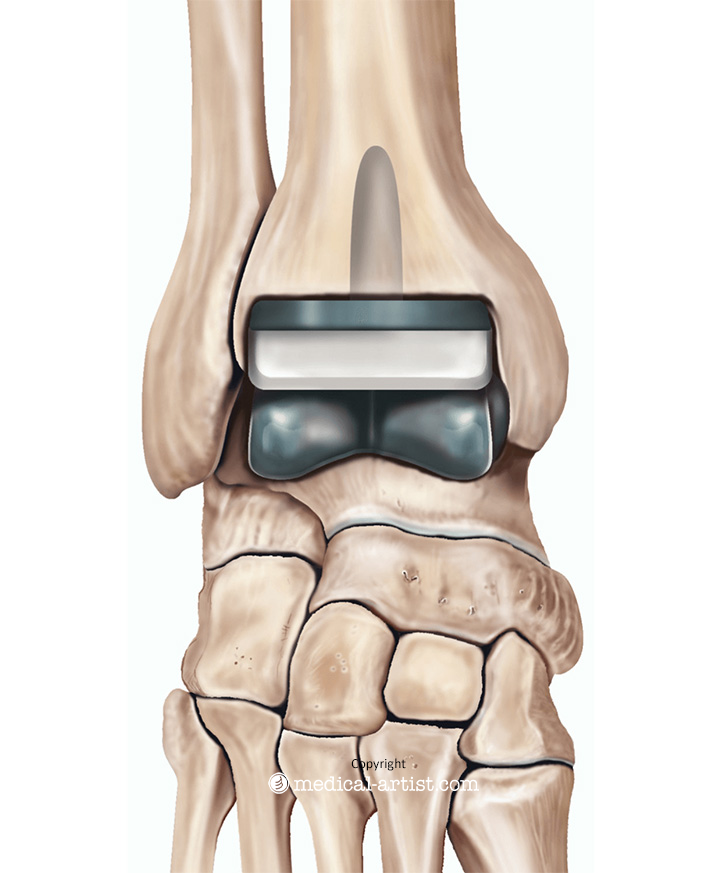
Your surgeon will make a cut on the front of your ankle and remove the damaged joint surfaces. They will replace these with an artificial joint made of metal and plastic.
Your ankle replacement is fixed to the bone using special coatings on the metal that bond directly to the bone.
How can I prepare myself for the operation?
If you smoke, stopping smoking now may reduce your risk of developing complications and will improve your long-term health.
Try to maintain a healthy weight. You have a higher risk of developing complications if you are overweight.
Regular exercise should help to prepare you for the operation, help you to recover and improve your long-term health. Before you start exercising, ask the healthcare team or your GP for advice.
Speak to the healthcare team about any vaccinations you might need to reduce your risk of serious illness while you recover. When you come into hospital, practise hand washing and wear a face covering when asked.
What complications can happen?
The healthcare team will try to reduce the risk of complications.
Any numbers which relate to risk are from studies of people who have had this operation. Your doctor may be able to tell you if the risk of a complication is higher or lower for you. Some risks are higher if you are older, obese, you are a smoker or have other health problems. These health problems include diabetes, heart disease or lung disease.
Some complications can be serious and may even cause death.
General complications of any operation
- Bleeding during or after the operation.
- Infection of the surgical site (wound).
- Allergic reaction to the equipment, materials or medication.
- Acute kidney injury.
- Difficulty passing urine.
- Venous thromboembolism (VTE). This is a blood clot in your leg (deep-vein thrombosis – DVT) or one that has moved to your lung (pulmonary embolus).
- Chest infection. Your risk will be lower if you have stopped smoking and you are free of COVID-19 (coronavirus) symptoms for at least 7 weeks before the operation.
- Heart attack. A heart attack can sometimes cause death.
- Stroke. A stroke can sometimes cause death.
Specific complications of this operation
- Damage to nerves around your ankle, leading to numbness or pain in your foot. This usually gets better but may be permanent.
- Damage to blood vessels around your ankle. You will need surgery straight away to restore the blood flow.
- Slow healing of your wound.
- Fracture of the bone on the inner side of your ankle during the operation or later on.
- Infection in your ankle, which can result in loosening and failure of your ankle replacement.
- Failure of your ankle replacement caused by loosening of the metal from the bone or tilting of your ankle.
- Continued discomfort in your ankle.
- Severe pain, stiffness and loss of use of your foot and ankle. Your foot and ankle can take months or years to improve. Sometimes there is permanent pain and stiffness.
- Surgery to redo the ankle replacement. About 9 in 10 ankle replacements will last 10 years.
- Difficulty passing urine.
Consequences of this procedure
- Pain.
- Unsightly scarring of your skin.
How soon will I recover?
You should be able to go home the same day.
To start with, spend most of the time with your leg raised on a chair or footstool.
You will need to have the cast or boot on for about 6 weeks. You should use walking aids until you can walk well without them.
Regular exercise should help you to return to normal activities as soon as possible. Before you start exercising, ask the healthcare team or your GP for advice.
Most people make a good recovery, have less pain, and can move about better. An artificial ankle never feels quite the same as a normal ankle, and it is important to look after it in the long term.
An ankle replacement can wear out with time.
Summary
Arthritis of your ankle is often the result of previous ankle injuries or rheumatoid arthritis. If you have severe pain, stiffness and disability, an ankle replacement should reduce your pain and still give you some movement in your ankle.
IMPORTANT INFORMATION
The operation and treatment information on this page is published under license by Healthdirect Australia from EIDO Healthcare Australia and is protected by copyright laws. Other than for your personal, non-commercial use, you may not copy, print out, download or otherwise reproduce any of the information. The information should not replace advice that your relevant health professional would give you. Medical Illustration Copyright © Medical-Artist.com.
For more on how this information was prepared, click here.
Learn more here about the development and quality assurance of healthdirect content.
Last reviewed: January 2026