Reversal of Hartmann's Procedure
What is Hartmann’s procedure?
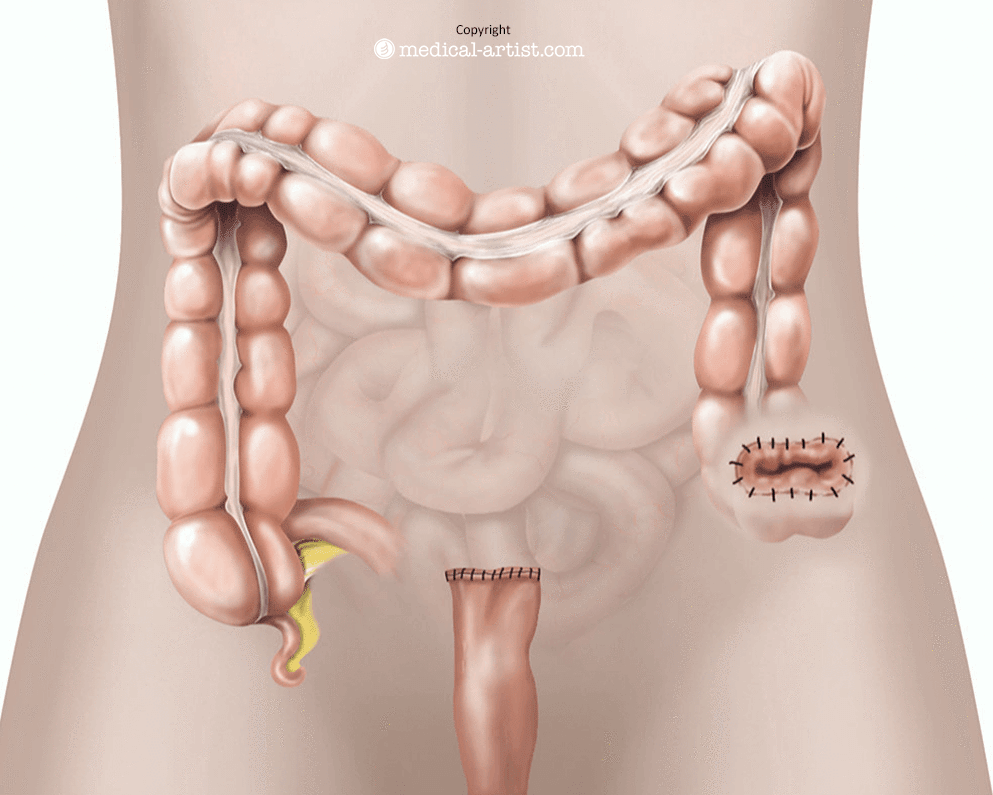
Hartmann’s procedure involves removing a piece of large bowel (colon). It is usually performed as an emergency. The two ends of bowel were not joined together because your surgeon decided the risks were too high. Your surgeon made a colostomy (your large bowel opening onto your skin). The other end was closed as a rectal stump. Your surgeon has decided it is safe to join the two ends of your bowel back together.
What are the benefits of surgery?
You should be able to open your bowels in the normal way and you should no longer have a stoma bag.
What will happen if I decide not to have the operation?
Your bowel will continue to open onto your skin and you will need to carry on using a stoma bag.
What does the operation involve?
The operation is performed under a general anaesthetic and usually takes about 90 minutes to 3 hours.
Your surgeon will free up the end of your bowel inside your abdomen and the end used to make the colostomy. Your surgeon will join the two ends back together and place your bowel inside your abdominal cavity.
How can I prepare myself for the operation?
If you smoke, stopping smoking now may reduce your risk of developing complications and will improve your long-term health.
Try to maintain a healthy weight. You have a higher risk of developing complications if you are overweight.
Regular exercise should help to prepare you for the operation, help you to recover and improve your long-term health. Before you start exercising, ask the healthcare team or your GP for advice.
Speak to the healthcare team about any vaccinations you might need to reduce your risk of serious illness while you recover. When you come into hospital, practise hand washing and wear a face covering when asked.
What complications can happen?
The healthcare team will try to reduce the risk of complications.
Any numbers which relate to risk are from studies of people who have had this operation. Your doctor may be able to tell you if the risk of a complication is higher or lower for you. Some risks are higher if you are older, obese, you are a smoker or have other health problems. These health problems include diabetes, heart disease or lung disease.
Some complications can be serious.
General complications of any operation
- Bleeding during or after the operation. You may need a blood transfusion.
- Infection of the surgical site (wound).
- Allergic reaction to the equipment, materials or medication.
- Acute kidney injury.
- Chest infection — your risk will be lower if you have stopped smoking and you are free of Covid-19 (coronavirus) symptoms for at least 7 weeks before the operation.
- Developing a hernia in the scar.
- Blood clot in your leg (deep-vein thrombosis - DVT).
- Blood clot in your lung (pulmonary embolus), if a blood clot moves through your bloodstream to your lungs.
Specific complications of this operation
Keyhole surgery complications
- Damage to structures such as your bowel, bladder or blood vessels when inserting instruments into your abdomen.
- Developing a hernia near one of the cuts used to insert the ports.
- Surgical emphysema (a crackling sensation in your skin caused by trapped carbon dioxide).
- Gas embolism. This is when gas (carbon dioxide) gets into the bloodstream and blocks a blood vessel.
Reversal of Hartmann's complications
- Anastomotic leak. This is a serious complication. You will often need another operation.
- Continued bowel paralysis (ileus), where your bowel stops working for more than a few days, causing you to become bloated and to be sick.
- Diarrhoea.
- Damage to other structures inside your abdomen. The blood vessels to your testicles or ovaries, small bowel, and your ureters are particularly at risk.
- Tissues can join together in an abnormal way (adhesions) when scar tissue develops inside your abdomen.
- Compartment syndrome causing pain and damage to your legs.
- Death. The risk is less the fitter you are.
Consequences of this procedure
- pain
- unsightly scarring of your skin
How soon will I recover?
It is usual for your bowel to stop working for a few days.
You should be able to go home after 5 to 10 days.
It can take up to 3 months to return to normal activities.
Regular exercise should help you to return to normal activities as soon as possible. Before you start exercising, ask the healthcare team or your GP for advice.
Most people make a good recovery.
Summary
Reversal of Hartmann’s procedure will allow you to open your bowels in the normal way. You will no longer need a stoma bag.
IMPORTANT INFORMATION
The operation and treatment information on this page is published under license by Healthdirect Australia from EIDO Healthcare Australia and is protected by copyright laws. Other than for your personal, non-commercial use, you may not copy, print out, download or otherwise reproduce any of the information. The information should not replace advice that your relevant health professional would give you. Medical Illustration Copyright © Medical-Artist.com.
For more on how this information was prepared, click here.
Learn more here about the development and quality assurance of healthdirect content.
Last reviewed: January 2026