
Ovarian torsion
If you suddenly develop severe abdominal (tummy) or pelvic pain, especially with nausea or vomiting, call triple zero (000) immediately or go to your nearest emergency department.
Key facts
- Ovarian torsion is when an ovary twists and cuts off its blood supply, leading to sudden lower tummy or pelvic pain.
- Ovarian torsion is a medical emergency and needs urgent hospital care to help save your ovary.
- It most often happens in females of reproductive age, but it can happen at any age.
- It is more likely to happen if you have an ovarian cyst or growth, are pregnant or are having fertility treatment.
- Early treatment gives the best chance of protecting the ovary and your future fertility.
What is ovarian torsion?
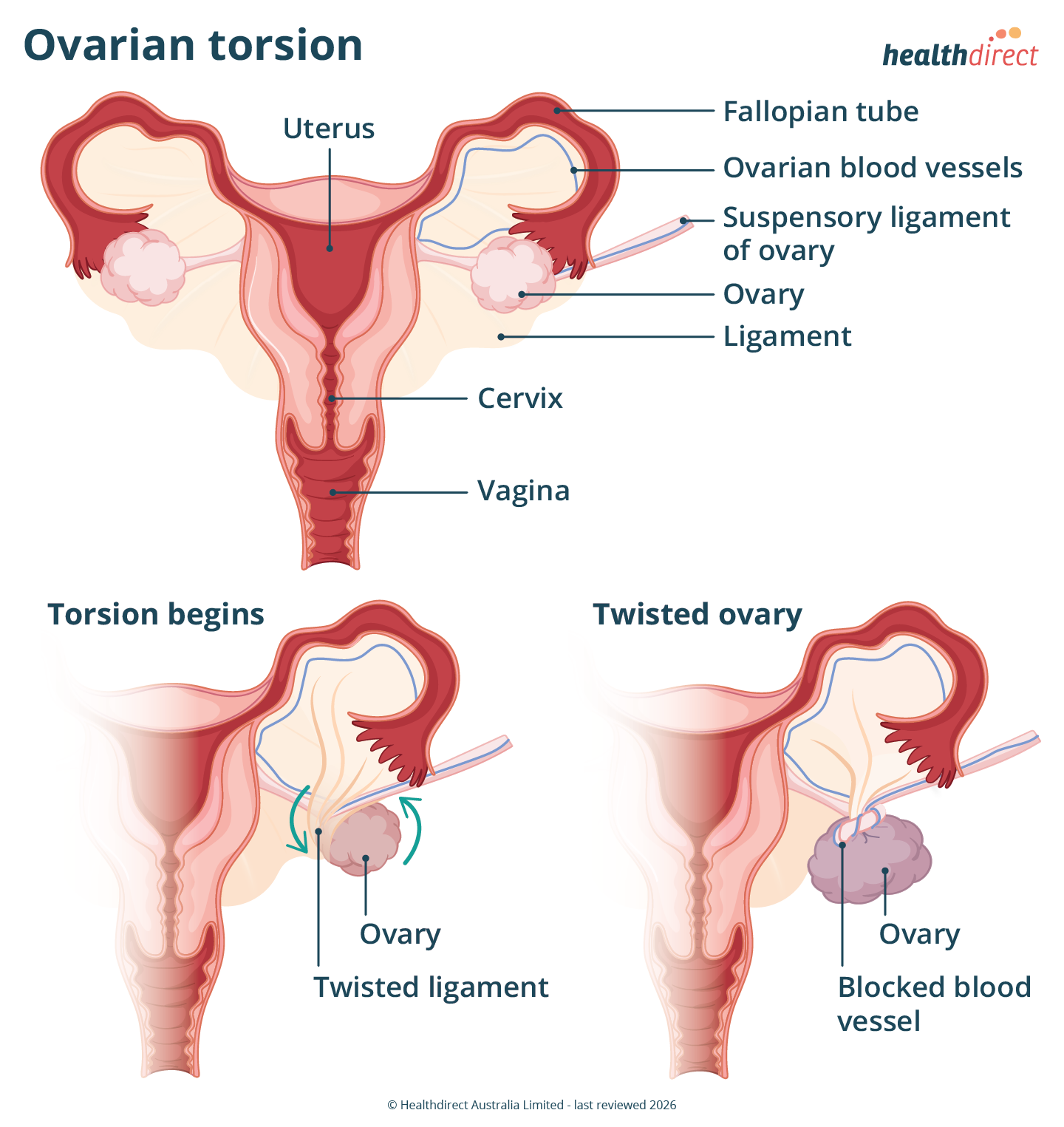
Ovarian torsion is when an ovary twists around the tissues that hold it in place. These tissues include ligaments (strong bands that support the ovary) and blood vessels that supply blood to the ovary.
Adnexal torsion is a broader term. It means a twist in the ovary, the fallopian tube (the tube that connects the ovary to your uterus) or both. It can also include twisting of nearby cysts (fluid-filled sacs).
Ovarian torsion is most common in females of reproductive age, but it can happen at any age.
Ovarian torsion and adnexal torsion are both medical emergencies.
What are the symptoms of ovarian torsion?
Ovarian torsion can lead to sudden, strong pain low in your tummy or pelvic area (the area below your belly button). Pain is more common on the right side and it may come and go or stay constant.
Other symptoms may include:
Ovarian cysts often have no symptoms. If an ovarian cyst causes your ovary to twist, you may also:
- feel tenderness when your pelvis is touched
- have pain that feels spread out across your lower tummy
- notice a smooth, rounded lump in your tummy that may feel sore
- look or feel unwell
These symptoms can also happen with other conditions, not just ovarian torsion. If you are not sure what is causing your symptoms, see your doctor. If you think you have ovarian torsion, go to your nearest hospital emergency department.
CHECK YOUR SYMPTOMS — Use the Symptom Checker and find out if you need to seek medical help.
What are the warning signs?
Warning signs include sudden sharp pain in your tummy, usually on one side. It may also start after a sudden movement, such as coughing or straining.
When should I call an ambulance or go to the emergency department?
If you suddenly get severe abdominal (tummy) or pelvic pain, especially with nausea or vomiting, seek emergency medical care. Call triple zero (000) and ask for an ambulance or go to a hospital emergency department straight away.
Also go to the emergency department if you have:
- ongoing tummy or pelvic pain that doesn’t go away
- mild tummy or pelvic pain with nausea and vomiting
- a known ovarian cyst and new pain
- tummy or pelvic pain and you are at higher risk of ovarian torsion
- tummy pain and might be pregnant
What should I do while waiting for the ambulance?
If someone is with you, ask them to pack a few essential items to take with you. You may need surgery.
Read more about how to prepare for surgery.
FIND A HEALTH SERVICE — The Service Finder can help you find doctors, pharmacies, hospitals and other health services.
What causes ovarian torsion?
Ovarian torsion happens when an ovary twists, cutting off its blood supply.
You may be at higher risk of ovarian torsion if you:
- have an ovarian cyst or growth
- are pregnant, especially in early pregnancy
- are having fertility treatment
- have had an ovarian torsion before
- have had pelvic surgery in the past
- have longer bands (ligaments) that support the ovary (more common in children before puberty)
- have polycystic ovary syndrome (PCOS)
How is ovarian torsion diagnosed?
Your doctor will ask about your symptoms and examine your tummy. If they think you may have ovarian torsion, they will refer you to hospital immediately for tests.
Tests may include:
If doctors still think torsion is likely, they will arrange emergency surgery. Seeing the ovary directly during surgery is the only way to confirm the diagnosis.
A computed tomography (CT) scan or magnetic resonance imaging (MRI) scan may be used if an ultrasound is not available or if the results are unclear.
Ovarian cysts are usually found by a pelvic exam or an ultrasound.
How is ovarian torsion treated?
Ovarian torsion is usually treated with emergency surgery. During surgery, the surgeon will untwist the ovary. This is called detorsion.
If a cyst caused the twist, it is usually removed at the same time. If the cyst is attached to the fallopian tube, part of the tube may also need to be removed.
Can ovarian torsion resolve by itself?
Ovarian torsion can sometimes untwist on its own. This is rare and does not mean your ovary is safe.
Because the ovary can become damaged quickly, surgery is usually recommended rather than waiting to see if it gets better by itself. Quick treatment gives the best chance of saving your ovary.
ASK YOUR DOCTOR — Preparing for an appointment? Use the Question Builder for general tips on what to ask your GP or specialist.
What are the complications of ovarian torsion?
If ovarian torsion is not treated quickly, it can cause problems because the twist blocks blood flow to your ovary. Without enough blood, your ovary can become damaged or stop working.
Possible complications include:
- shrinking or damage to the ovary (ovarian atrophy) — when blood can’t reach your ovary, it may stop working properly, even after it’s untwisted
- infection inside the tummy (peritonitis) — a rare but serious infection that can happen if the ovary is not removed and becomes infected
- loss of the ovary or fallopian tube — if the ovary does not recover its blood supply, the surgeon may need to remove your ovary to prevent further complications
Fast treatment gives the best chance of saving the ovary and protecting your fertility (the ability to have children). If the ovary is badly damaged or needs to be removed, this can reduce your fertility because fewer eggs are available. Losing one ovary usually does not cause infertility, but it may lower your chance of becoming pregnant.
Can ovarian torsion be prevented?
Ovarian torsion can’t always be prevented but your doctor can help you lower the chance of it happening again.
If you often get ovarian cysts, your doctor may suggest medicines that stop ovulation. These medicines help prevent new cysts from forming. This can lower the chance of the ovary twisting again.
Resources and support
- The Royal Australian and New Zealand College of Obstetricians and Gynaecologists (RANZCOG) has tools and resources on a range of female health topics.
- Hormones Australia has information about ovaries.
- Jean Hailes has information on ovarian cysts and also about the ovaries and uterus.
You can call the healthdirect helpline on 1800 022 222 (known as NURSE-ON-CALL in Victoria). A registered nurse is available to speak with you 24 hours a day, 7 days a week.
Languages other than English
The Royal Women’s Hospital has information on common gynaecological issues in many community languages.
Information for Aboriginal and/or Torres Strait Islander peoples
Westmead Hospital Women's and Newborn Health offers fact sheets and videos on Aboriginal Women's Health.
Learn more here about the development and quality assurance of healthdirect content.
Last reviewed: February 2026