
Duodenal ulcer
Key facts
- A duodenal ulcer is a sore in the lining of part of your small intestine.
- You may experience stomach pain, bloating or nausea with a duodenal ulcer.
- A duodenal ulcer can be caused by Helicobacter pylori bacteria or medicines such as some anti-inflammatory medicines that harm the protective lining of your small intestine.
- The best way to treat a duodenal ulcer depends on its cause.
- If left untreated, a duodenal ulcer can lead to bleeding or a hole in the bowel.
What is a duodenal ulcer?
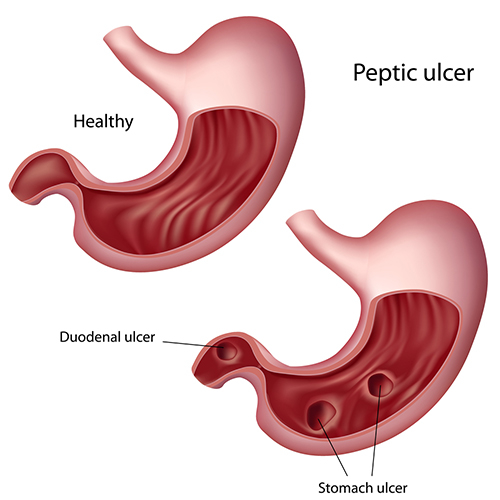
A duodenal ulcer is a sore that forms in the lining of the duodenum. Your duodenum is the first part of your small intestine, just beyond the stomach. These ulcers often cause pain in the upper abdomen (tummy area), just below the breastbone.
You can also get an ulcer in your stomach. Stomach ulcers and duodenal ulcers are 2 types of peptic ulcers. If you have either of these, you have what's called 'peptic ulcer disease'. Once treated, they usually get better within a few weeks to months.
What are the symptoms of a duodenal ulcer?
If you have a duodenal ulcer, you might:
- have pain in your abdomen (stomach or tummy area)
- feel full and bloated after eating
- feel like you might vomit
- lose weight
- have heartburn
- feel discomfort when swallowing or eating
Your stomach pain may come and go. It can often be relieved by eating food or taking an antacid medicine. Sometimes food makes the pain worse. This can happen immediately or soon after eating.
If an ulcer causes complications, you may experience:
- sudden, severe pain in your stomach that doesn't go away
- vomit or stools (poo) that look bloody or a black colour
CHECK YOUR SYMPTOMS — Use the Symptom Checker and find out if you need to seek medical help.
What causes duodenal ulcers?
A duodenal ulcer is usually caused by a type of bacteria called Helicobacter pylori, or H. pylori.
The bacteria can weaken the protective lining of your duodenum. If the protective lining is damaged, an ulcer can form.
Some medicines can also cause duodenal ulcers, particularly anti-inflammatory medicines such as ibuprofen and aspirin — these are also known as NSAIDs. They can sometimes harm the protective lining, allowing acid to create an ulcer.
If you are undergoing treatment for cancer, you are at a higher risk of developing a duodenal ulcer.
There are some lifestyle factors that may make you more likely to have a duodenal ulcer, such as:
- smoking
- drinking a lot of alcohol
- health conditions such as Crohn's disease or cystic fibrosis
- experiencing stress
When should I see my doctor?
See your doctor if you:
- experience abdominal pain
- feel nauseous
- lose weight without trying to
Go to the emergency department if:
- you have sudden severe pain in your stomach that doesn't go away
- your vomit or stools (poo) look bloody or a black colour
If you have severe pain in your abdomen that doesn't go away, or if you have blood in your vomit, go to your nearest hospital emergency department immediately or call triple zero (000) and ask for an ambulance.
FIND A HEALTH SERVICE — The Service Finder can help you find doctors, pharmacies, hospitals and other health services.
How are duodenal ulcers diagnosed?
To diagnose a duodenal ulcer, your doctor will talk to you and examine you. They will probably arrange a test to find out if you have H. pylori in your body. These tests may include:
- a blood test
- a stool (poo) sample
- a breath test
Your doctor may also arrange for you to have a gastroscopy. This is also called an endoscopy. During an endoscopy a specialist doctor uses a thin, flexible tube with a camera on the end to look inside your stomach and duodenum. This way they can see any ulcers or changes.
If you have a gastroscopy, your surgeon might take a sample of tissue, called a biopsy, to test for H. pylori.
How are duodenal ulcers treated?
If your ulcer is caused by H. pylori, the usual treatment is 'triple therapy'. This means taking 2 antibiotics and a proton pump inhibitor (PPI) medicine. The antibiotics kill the bacteria, while the PPI medicine reduces the acid made by your stomach.
If you don't have H. pylori infection and you have been using anti-inflammatory medicines, you will be advised to stop taking them if possible. You will also need to start taking a PPI medicine to reduce acid production in your stomach.
You can make some other changes to improve your symptoms, such as:
- quitting smoking
- drinking less alcohol
- losing weight if you are living with obesity
- eating smaller meals
- trying to manage your stress
- having your evening meal a few hours before bedtime
- avoiding coffee, fatty foods, spicy foods and acidic foods such as tomato
What are the complications of duodenal ulcers?
If left untreated, your duodenal ulcer may get worse. This can cause complications, such as:
- bleeding — this can vary from a small amount to a serious, life-threatening bleed
- perforation — this is when the ulcer goes all the way through the wall of the duodenum, causing food and acid to leak into your abdomen
These complications can cause sharp pain, bloody vomit or bloody stools (poo) and require emergency treatment.
Can duodenal ulcers be prevented?
There are lifestyle changes that you can make to avoid duodenal ulcers. These include:
- taking NSAIDs with food, if you need to take them
- stopping smoking
- eating a healthy and well-balanced diet
If you have H. pylori infection, taking antibiotics to treat the infection can reduce your risk of getting an ulcer. Practicing good hygiene can help prevent infection.
Resources and support
Visit the Gastroenterological Society of Australia for information about Helicobacter pylori and endoscopies.
Read the Royal Children's Hospital fact sheet on H. pylori.
The Emergency Care Institute peptic ulcer disease factsheet has tips on care at home if you have a duodenal ulcer.
You can also call the healthdirect helpline on 1800 022 222 (known as NURSE-ON-CALL in Victoria). A registered nurse is available to speak with you 24 hours a day, 7 days a week.
Learn more here about the development and quality assurance of healthdirect content.
Last reviewed: February 2026