

Morning sickness
Key facts
- Morning sickness is a feeling of nausea or vomiting (being sick) during pregnancy.
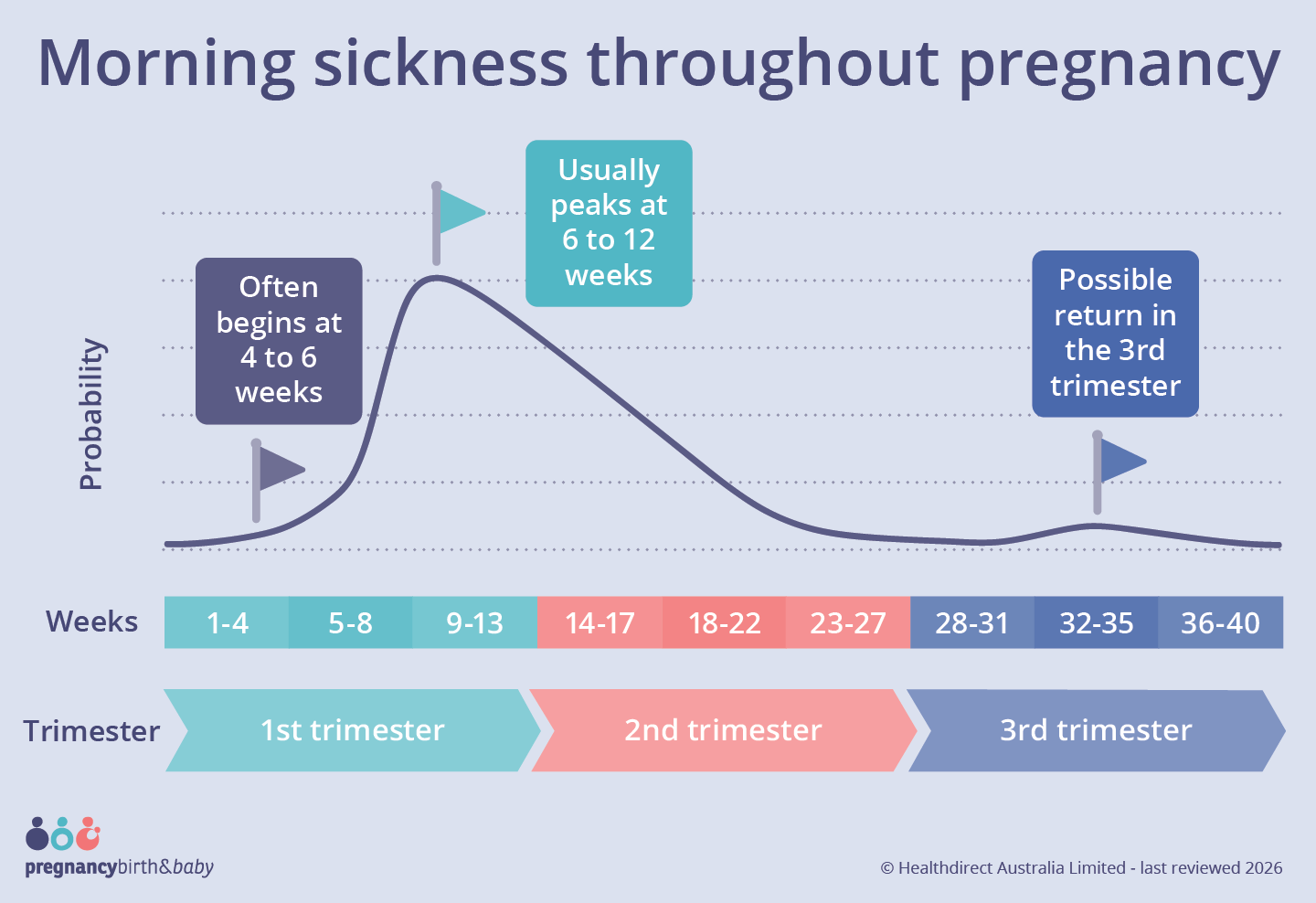
- You are more likely to have morning sickness during your first trimester.
- For some people, morning sickness can last all the way through their pregnancy.
- There is no research to show that morning sickness causes harm to your baby.
- Some women are more likely to get morning sickness than others — it's hard to predict.
What is morning sickness?
Morning sickness is a feeling of nausea or vomiting (being sick) during pregnancy. Despite its name, morning sickness can happen at any time of the day or night.
When will I get morning sickness?
You are more likely to have morning sickness between weeks 6 and 14 of pregnancy. This is during your first trimester.
However, it can last up to weeks 14 to 20. For many women, the feelings of sickness will be over by the second trimester.
Most pregnant women have morning sickness at some point.
Is morning sickness harmful for my baby?
There is no research to show that morning sickness causes harm to your baby, unless it is very severe.
Nausea and feeling sick can impact your food choices. Both you and your baby need a good variety of nutrients in the foods you eat. Try to eat small, frequent meals throughout the day.
Speak with a health professional if you think that your morning sickness is getting in the way of healthy eating.
It's also important to avoid dehydration. If you are vomiting and can't keep fluids down, see your doctor immediately.
What are the symptoms of morning sickness?
Morning sickness is a feeling of nausea or vomiting (being sick).
This can range from mild, which is often seen as a normal part of pregnancy, to severe, where you need medical help.
CHECK YOUR SYMPTOMS — Use the Symptom Checker and find out if you need to seek medical help.
Hyperemesis gravidarum
When morning sickness is very severe, it is called hyperemesis gravidarum. This makes it hard for you to eat and drink enough. Untreated, it can lead to weight loss and dehydration.
Very severe morning sickness during pregnancy can be difficult. It can impact how well you live. You may need to go to the hospital for treatment. Some people become depressed or anxious.
If you are having are hard time dealing with hyperemesis gravidarum, ask your midwife, doctor or maternity care provider for help.
What causes morning sickness?
The exact cause of morning sickness is not known. It probably has something to do with hormonal changes that happen during pregnancy.
Having a balanced diet during your pregnancy will help you stay healthy. It is important to pay special attention to the 5 food groups. The best foods to eat are whole foods. Whole foods are those that are fresh and have not been processed.
When should I see my midwife or doctor?
If nausea or vomiting is causing you a lot of discomfort, or if you think that you have hyperemesis gravidarum, you should see your midwife, doctor or maternity care provider.
Other signs you need to see your doctor are:
- very dark urine (wee)
- blood in your vomit
- extreme tiredness
- a large amount of weight loss
- dehydration — when you can’t keep fluids down
FIND A HEALTH SERVICE — The Service Finder can help you find doctors, pharmacies, hospitals and other health services.
How is morning sickness diagnosed?
You midwife or doctor will ask you questions and can diagnose morning sickness based on your symptoms.
If you have hyperemesis gravidarum you might be sent for some tests, such as:
How is morning sickness treated?
Self-care at home
To ease morning sickness, you can try some things at home, like:
- eating a plain cracker shortly after waking up
- eating protein-rich foods (such as nuts or cheese)
- not missing meals
- eating smaller meals more often — include morning and afternoon snacks between main meals
- not eating spicy or fatty foods
- trying to drink 8 glasses of water a day
- drinking water before and after a meal — not with food
You may find that soda water (carbonated or fizzy water), ginger tea and peppermint tea help relieve your nausea. They can also settle an upset stomach.
Some people become more sensitive to strong food smells while pregnant. If certain smells bother you, consider asking for help preparing food.
Opening windows or using a fan when cooking can help get rid of cooking smells.
Cold foods don’t smell as much as hot foods. These may be a better choice for someone with morning sickness.
Nausea may feel worse when you are over-tired. Try taking a nap or having a rest during the day.
Other things that may help with morning sickness are:
- deep breathing or relaxation exercises
- anti-nausea wristbands — these can be bought at a pharmacy
- acupuncture treatments — when given by a qualified practitioner trained in maternal care
Medicines for morning sickness
If your symptoms are severe or don’t get better, your midwife or doctor might suggest antiemetic medicine, which helps stop nausea and vomiting.
Be sure to check with your midwife, doctor or maternity care provider before you take any supplement, prescription or over-the-counter medicine, while pregnant.
Check for information on your medicine.
LOOKING FOR A MEDICINE? — To search by brand name or active ingredient, use the Medicines information search feature.
Other treatment options
Your midwife, doctor or maternity care provider might:
- refer you to another healthcare professional, such as a dietitian. A dietitian can help you create a healthy and enjoyable meal plan.
- choose to send you to a specialist for further tests.
- prescribe you a medicine to ease your symptoms. Some medicines can prevent vomiting. You also might be given extra vitamin and mineral tablets.
If your symptoms don’t go away after treatment, it’s a good idea to see your doctor or healthcare provider again. You might be able to try different options.
What are the complications of morning sickness?
If you are vomiting whenever you eat or drink, seek help. Early treatment can protect you and your baby from health complications. If morning sickness is not treated, you can get dehydrated and weak. It can also affect your mental health.
If you have severe vomiting for a long time, you may need monitoring and treatment in hospital.
In hospital, an intravenous (IV) drip is put into a vein in your arm. This is used to give the salts and fluids you need. It will also prevent dehydration.
Can morning sickness be prevented?
Some people are more likely to have nausea during pregnancy than others. Morning sickness is hard to predict.
Women who had morning sickness during a past pregnancy are more likely to have it again. Talk to your midwife, doctor or maternity care provider about what you can do to reduce morning sickness during your next pregnancy.
Some women who get travel sickness or migraines can also be more likely to have morning sickness.
Resources and support
- To learn more about both nausea and vomiting in pregnancy and hyperemesis gravidarum you can visit the Hyperemesis Australia website.
- The Royal Women's Hospital has a fachseet on coping with nausea and vomiting in pregnancy.
- You may also want to look at the resources and support provided by PANDA — Perinatal Anxiety & Depression Australia. PANDA specialises in supporting families during pregnancy and the first year of your child's life. You can also call PANDA on 1300 726 306.
- Find out about Ready to COPE, a free weekly email series that covers pregnancy, birth and the first year of being a parent.
Languages other than English
- You can read the factsheet from the Royal Women's Hospital about nausea and vomiting in pregnancy in multiple languages through the Health Translations website.
- NSW Health has information about hyperemesis gravidarum translated into multiple community languages.

Speak to a maternal child health nurse
Call Pregnancy, Birth and Baby to speak to a maternal child health nurse on 1800 882 436 or video call. Available 7am to midnight (AET), 7 days a week.
Learn more here about the development and quality assurance of healthdirect content.
Last reviewed: October 2025