Skin cancer and melanoma
Key facts
- Skin cancer occurs when skin cells grow abnormally, usually after too much exposure to ultraviolet (UV) radiation from the sun.
- The 3 main types of skin cancer are basal cell carcinoma (BCC), squamous cell carcinoma (SCC) and melanoma — melanoma is the most dangerous type.
- Anyone can get skin cancer, but it is more common in older people, people with fair or freckled skin and those with a family history.
- There are several ways to treat skin cancer, depending on the type, its size and location, and whether it has spread.
- Most skin cancers are successfully treated — especially if you find them early.
What is skin cancer and melanoma?
Skin cancer is a disease that occurs when your skin cells grow abnormally.
The uncontrolled growth of abnormal cells forms a tumour in your skin. Tumours are either benign (non-cancerous), or malignant (cancerous).
Skin cancer is the most common type of cancer diagnosed in Australia. Australia has one of the highest rates of skin cancer in the world. This is probably because many people have fair skin and are exposed to the sun from early childhood.
There are 3 main types of skin cancers. They are named according to which layer of your skin they start in:
- Basal cell carcinoma (BCC) begins in the lower layer of the epidermis (outer layer of your skin). BCC tumours tend to grow slowly and rarely spread to other parts of your body. About 2 out of every 3 skin cancers are BCC.
- Squamous cell carcinoma (SCC) grows from the flat cells found in the top layer of your epidermis. SCC can grow quickly on the skin over several weeks or months. About 1 out of every 3 skin cancers are SCC. Bowen's disease is an early form of SCC in the top layer of skin.
- Melanoma grows from cells called melanocytes. These are the cells that give your skin its colour. Melanoma is the rarest type of skin cancer — 1 or 2 out of every 100 skin cancers are melanoma. It is the most serious skin cancer because it is more likely to spread.
Melanoma can spread quickly (metastasise) throughout the body. It can be treated if found early.
BCC and SCC are also called non-melanoma skin cancers. Over 1 million treatments are given each year in Australia for non-melanoma skin cancers.
Skin cancer is mostly preventable, and there are effective treatment options available.
What are the symptoms of skin cancer?
The first symptoms of skin cancer may be a spot, lump or scaly area on your skin.
You may have a mole that changes colour, size or shape over several weeks or months.
Skin cancers may bleed and become inflamed. They can be tender to the touch.
Changes may include a spot or lump on your skin that grows quickly and is:
- thick
- scaly or crusted
- shiny
- pale or bright pink in colour
Skin cancer can be anywhere on your body but is most often found on areas frequently exposed to the sun.
Not all melanomas look the same. See your doctor if you notice changes to your skin.
CHECK YOUR SYMPTOMS — Use the Symptom Checker and find out if you need to seek medical help.
What causes skin cancer?
Almost all skin cancers in Australia are caused by too much exposure to UV radiation. This is the part of sunlight that causes tanning, sunburn and skin damage over time. UV radiation also comes from non-natural sources such as sun beds (solariums).
While anyone can get skin cancer, it gets more common as you get older. The risk is also higher if you have:
- previously had skin cancer or have family history of skin cancer
- fair or freckled skin, particularly if it burns easily or doesn't tan
- red or fair hair and light-coloured eyes
- a weakened immune system (such as after surgery, or from an ongoing condition like leukaemia)
- sunspots or irregular moles on your body
- worked, played sport or spent leisure time in the sun
- actively tan or use sun beds
If you have olive or dark skin, your skin produces more melanin, which protects to some extent against UV radiation. However, it's still possible for you to develop skin cancer.
When should I see my doctor?
Consider seeing your doctor once a year for a skin check if you think you have any risk factors that put you at higher risk of skin cancer.
It's important to check your own skin regularly to find any new or changing spots.
See your doctor or dermatologist straight away if you notice any changes to your skin, such as:
- small lumps that are red, pale or pearly in colour
- a spot that looks or feels different from any others
- a spot or mole that changes size, shape, colour or texture over time
- a sore that doesn't go away after a few weeks
- a sore that itches or bleeds
Your doctor can help you tell the difference between a harmless spot such as a mole, and a sunspot or irregular mole that could develop later into skin cancer.
You can also use the 'ABCDE' of skin cancer when checking your skin:
- Asymmetry — does each side of the spot or mole look different from the other?
- Border — is it irregular, jagged or spreading?
- Colours — are there several, or is the colour uneven or blotchy?
- Diameter — look for spots that are getting bigger
- Evolution — is the spot or mole changing or growing over time?
Read more about checking for skin cancer.
FIND A HEALTH SERVICE — The Service Finder can help you find doctors, pharmacies, hospitals and other health services.
How is skin cancer diagnosed?
Your doctor or dermatologist will ask about your symptoms and family history. They will look closely at your skin to identify any suspicious spots using a dermatoscope (a magnifying glass for the skin).
It's not always possible to tell from looking at it whether a spot or lump is cancerous or not. Your doctor or dermatologist may take a skin biopsy to help with a diagnosis. This is where a part or all of your spot is removed and sent off to be looked at under a microscope.
Some smartphone apps allow you to photograph your skin and compare photos over time. While they can be a good reminder to check your skin and record details, they shouldn't replace a visit to the doctor.
Diagnosing melanoma
Your doctor will take a biopsy if they think you could have a melanoma. Your doctor may also check and take samples from nearby lymph nodes. The samples are then sent for testing to check if your spot is a melanoma. Sometimes, you will have an ultrasound or other imaging of your lymph nodes.
Melanomas are graded according to how far they have spread throughout the body:
- Stage 0 to 2 refers to early melanoma that has not spread from your skin.
- Stage 3 melanoma (regional) has spread to nearby lymph nodes, skin or tissues.
- Stage 4 melanoma (advanced, metastatic) has spread to other parts of your body.
Your doctor may suggest genomic testing (looking for genetic differences) if you have stage 3 or 4 melanoma. Results of these tests help your doctor choose the best treatment.
How is skin cancer treated?
Skin cancer treatment depends on the type, its size and location and whether it has spread elsewhere. Most skin cancers are successfully treated — especially if detected early.
Surgical treatments
Surgery is the most common treatment for skin cancer. Some cancers are completely removed during the biopsy. In that case, you won't need any further treatment.
Often, non-melanoma skin cancer removal can be done by your doctor. When removing a suspected cancer, your doctor will also cut out some nearby skin around the edges for testing. If they find more cancer cells, you may need further surgery or radiation therapy.
If you have a large skin cancer removed, you may need a skin graft (a small patch of skin taken from elsewhere on your body) to cover the wound.
For cancers in areas such as near your eyes, nose, lips or ears, a technique called Mohs surgery (microscopically controlled excision) may be used. A specially trained doctor or dermatologist will do this procedure.
Other surgical methods include curettage (removal of tissue with a spoon shaped instrument with a sharp edge) and electrodessication (cautery — burning to remove tissue). These methods are usually performed by a dermatologist.
Other treatments
Other treatments may include:
- Topical treatments — these include applying cream, lotion or gel to the skin. The treated skin usually blisters, peels or cracks for several weeks — this is a sign the cancer cells are being destroyed, and new, healthy skin will replace it.
- Cryotherapy — liquid nitrogen is used to freeze and remove sunspots and some small BCCs.
- Photodynamic therapy — this involves applying cream that makes skin cancer sensitive to light and then using a light source on the spot.
- Radiation therapy (radiotherapy) — radiation is used to destroy cancer in areas less suitable to surgery (such as your face). It may also be used after surgery to reduce the likelihood of the cancer returning.
- Lymph node biopsy — your doctor may recommend removing the lymph nodes which are close to the skin cancer to reduce the risk of cancer returning or spreading. This can also help you and your doctor understand how far the cancer has spread.
- Chemotherapy — some people with melanoma are treated with chemotherapy or immunotherapy along with surgery.
Are there complications of skin cancer treatment?
Skin cancer treatments can involve some damage to healthy skin around where the cancer is removed. Side effects of skin cancer treatment may include:
- pain or itching where the skin has been treated, or if lymph nodes have been removed
- scarring or changes to skin colour after a skin cancer has been removed
- bleeding during or after surgery for more complicated skin cancers
- reactions to medicines used in treatment or surgery
- lymphoedema — if your lymph nodes have been removed, your neck, arm or leg may swell with fluid
Discuss with your doctor if these problems apply to the treatment you are having.
All medicines can have side effects. Ask your doctor or pharmacist for information about your medicines.
Ask your doctor or other members of your health team for advice straight away if you have any complications after treatment.
ASK YOUR DOCTOR — Preparing for an appointment? Use the Question Builder for general tips on what to ask your GP or specialist.
Can skin cancer be prevented?
Skin cancer is almost entirely preventable. Making sun protection a part of your life, avoiding sunburn, and checking your skin regularly will help prevent further damage to your skin.
Protect your skin from UV radiation and help prevent skin cancer by following these steps:
- Slip on sun-protective clothing — cover your shoulders, neck, arms, legs and body.
- Slop on sunscreen that's rated SPF 50+ or higher, broad-spectrum and water resistant.
- Slap on a hat that shades your face, head, neck and ears.
- Seek shade under trees, umbrellas and buildings, away from direct sunlight and reflective surfaces.
- Slide on sunglasses to protect your eyes and surrounding skin.
- Stay away from sun lamps, solariums or sunbeds, because they have dangerous levels of UV radiation.
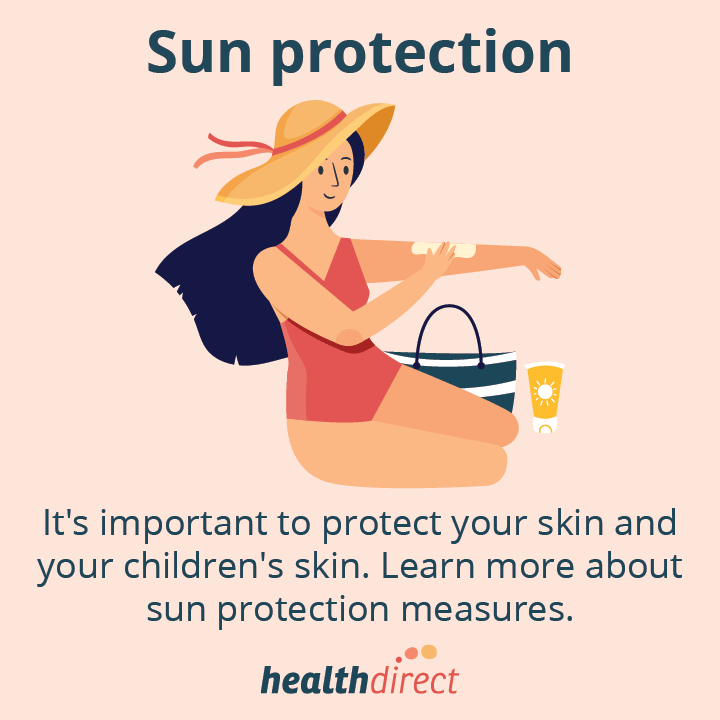
UV radiation from the sun varies depending on time of day, season, where you live and cloud coverage. Protect your skin whenever UV Index levels are above 3. Use Cancer Council Australia's free SunSmart app to check the UV Index for your area any time.
While using fake tanning cream isn't harmful to your skin, it offers no protection from UV radiation. You still need to protect yourself from the sun.
Sun exposure and vitamin D
The risks and benefits of sun exposure are not the same for all Australians.
Babies and children should be protected from the sun, since they are particularly vulnerable to harm from UV radiation.
If you have a high chance of skin cancer, it's essential to use sun protection all the time.
Light skinned Australians will get enough vitamin D from short periods of time outside. When UV levels are 3 or higher, you can get enough vitamin D with just a few minutes of sun exposure. Ten minutes outside wearing a short-sleeved shirt is enough in the summer. In winter about 20 to 30 minutes may be needed.
If you have darker skin, you are likely to have a low chance of getting skin cancer but a higher chance of vitamin D deficiency. You should spend some time outside in the middle of the day to help your body produce enough vitamin D.
If you live in a southern part of Australia, you may need to spend more time outside to make enough vitamin D.
Some people are at a higher risk of vitamin D deficiency:
- people who wear concealing clothing
- naturally very dark-skinned people
- people who spend long hours indoors, especially people who are housebound or live in a care home
- older adults
- people with obesity
- babies and infants of vitamin D deficient mothers
If you are at risk of vitamin D deficiency or cannot spend time outside, talk to your doctor. They may recommend taking a supplement.
Resources and support
It can be a shock to find out you have skin cancer. Talk to your doctor or a friend or family member for emotional support.
For more information and help, try these resources:
- Call the Cancer Council on 13 11 20 for free confidential support.
- Download the free Cancer Council SunSmart app for sun protection alerts, UV data, the 7-day weather forecast and a sunscreen calculator.
- Melanoma Patients Australia (MPA) has support groups and other resources for people affected by melanoma.
- SunSmart Victoria has information about skin cancer research, and free resources for school-aged children.
You can also call the healthdirect helpline on 1800 022 222 (known as NURSE-ON-CALL in Victoria). A registered nurse is available to speak with you 24 hours a day, 7 days a week.
Languages other than English
Call the Australian Government's Translating and Interpreting Service (TIS National) on 13 14 50 to get information through an interpreter.
Cancer Council NSW's website is available in several languages, such as Arabic, Chinese, Greek, Italian, Vietnamese and more and offers fact sheets in multiple languages.
Health Translations Victoria also offers translated fact sheets about skin cancer.
Learn more here about the development and quality assurance of healthdirect content.
Last reviewed: October 2025