
External condom
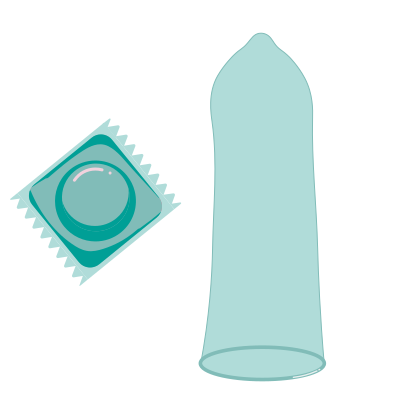
A thin cover worn over the penis during sex.
Overview
Does it have any other names?
Condom, male condom, rubber.
What is it?
A thin cover worn over the penis during sex. They are commonly made from latex (natural rubber), but non-latex condoms made from polyurethane (plastic) or polyisoprene (synthetic rubber) are also available.
What can it be used for?
- Preventing pregnancy.
- Reducing transmission of STIs.
How it works
How does it work?
The external condom is placed over the penis, creating a barrier between bodily fluids. It collects semen so sperm do not enter the vagina and cannot fertilise an egg.
It also reduces exposure to STIs by limiting contact with bodily fluids.
How quickly does it start working?
As soon as the condom is correctly placed over the penis, it starts working straight away to prevent pregnancy. However, it must be in place before any genital contact occurs.
Effectiveness
How effective is it at preventing pregnancy?
Typical use: 87% effective.
Perfect use: 98% effective.
What does perfect use look like?
- Make sure the condom hasn’t expired.
- Open the packet carefully, making sure not to tear the condom.
- Place the condom on the penis before any genital contact occurs.
- Use a condom that is the right size — not too tight and not too loose.
- Make sure the condom is rolled all the way down and stays on during sex.
- Use a new condom each time you have sex (if having sex multiple times in a row) and if switching between different types of sex (for example, vaginal to anal sex).
- Use lubricant (lube) to prevent the condom breaking during anal sex. Lube can also be used during vaginal sex for extra comfort.
- Only use water or silicone-based lube with condoms. Do not use oil-based products.
- Take it off carefully after sex, ensuring semen doesn’t spill out or come in contact with genitals. Throw it in the bin, don’t flush it down the toilet.
- Do not use it together with an internal condom.
Condoms come in different sizes, materials and shapes. Using a condom that fits well and feels comfortable can help prevent it from breaking or slipping off and makes it easier to use correctly every time.
Does anything decrease its effectiveness at preventing pregnancy?
The effectiveness of condoms can be reduced if:
- they are not used every time you have sex
- they are not used from start to finish — putting it on after sex has started or removing it before sex has finished
- they break, slip, or leak — this can happen if the condom is damaged, the wrong size, opened with a sharp object (like fingernails, teeth or jewellery) or used after the expiry date
- they are used with oil-based products (like some lubricants) — these can weaken latex condoms
- they are used with spermicide — this is not recommended and may increase the chance of condoms breaking
- lube is added to the inside of the condom or the outside of the penis before using a condom — this increases the chances of the condom slipping
- they are used with the internal condom — using an internal and external condom together can cause breakage due to friction
- they are not stored correctly — heat (like storing them in a car glovebox), friction (like storing them in a wallet) or damage to the packaging can weaken the condom
Does it prevent sexually transmitted infections (STIs)?
Yes. When used correctly, external condoms protect against STIs. They are more effective than internal condoms.
Usage and considerations
How frequently does it need to be used or replaced?
A new condom needs to be used each time you have sex, from start to finish. Condoms are single use only and should never be reused.
You should also use a new condom if:
- sex continues after ejaculation
- the condom breaks, slips or is taken off
- you switch between different types of sex (for example, vaginal to anal sex)
Will anyone be able to detect if I am using this method of contraception?
If you use condoms, both you and your partner(s) will be aware, as condoms are used at the time of sex and require partner involvement.
Safety and side effects
Are there any side effects?
Most people have no side effects when using condoms, but a small number of people may notice mild side effects such as:
- skin irritation in the vagina, vulva or anus of sexual partners, often due to friction. This can usually be improved by using more lubricant
- latex allergies are uncommon, but could cause itching, redness or swelling. Latex-free condoms are readily available
- some condoms have extra substances (such as warming, cooling or flavoured coatings) that can irritate sensitive skin
Are there any health conditions or lifestyle factors that might prevent me from using this type of contraception?
If you or your partner(s) are allergic or sensitive to latex, you should use non-latex condoms which are readily available.
Access and cost
How do I access it?
Condoms do not require a prescription and can be bought at:
- pharmacies
- supermarkets
- convenience stores
- online stores
Condoms can also be accessed for free at some locations, such as sexual health clinics.
What costs do I need to consider?
Condoms range in price with a packet of 10–12 costing between $5–10. They can also be bought in bulk packets which makes them cheaper.
You can get condoms for free at some places, such as sexual health clinics.
Fertility and future planning
Will it impact my future fertility?
No, condoms have no impact on your future fertility. You could fall pregnant as soon as you stop using this method.
Can I use this type of contraception after having a baby?
External condoms can be safely used straight away after having a baby.
Disclaimer
Last reviewed: August 2026